After each published period, the leaderboard updates. This is the page you'll either celebrate on or learn from.
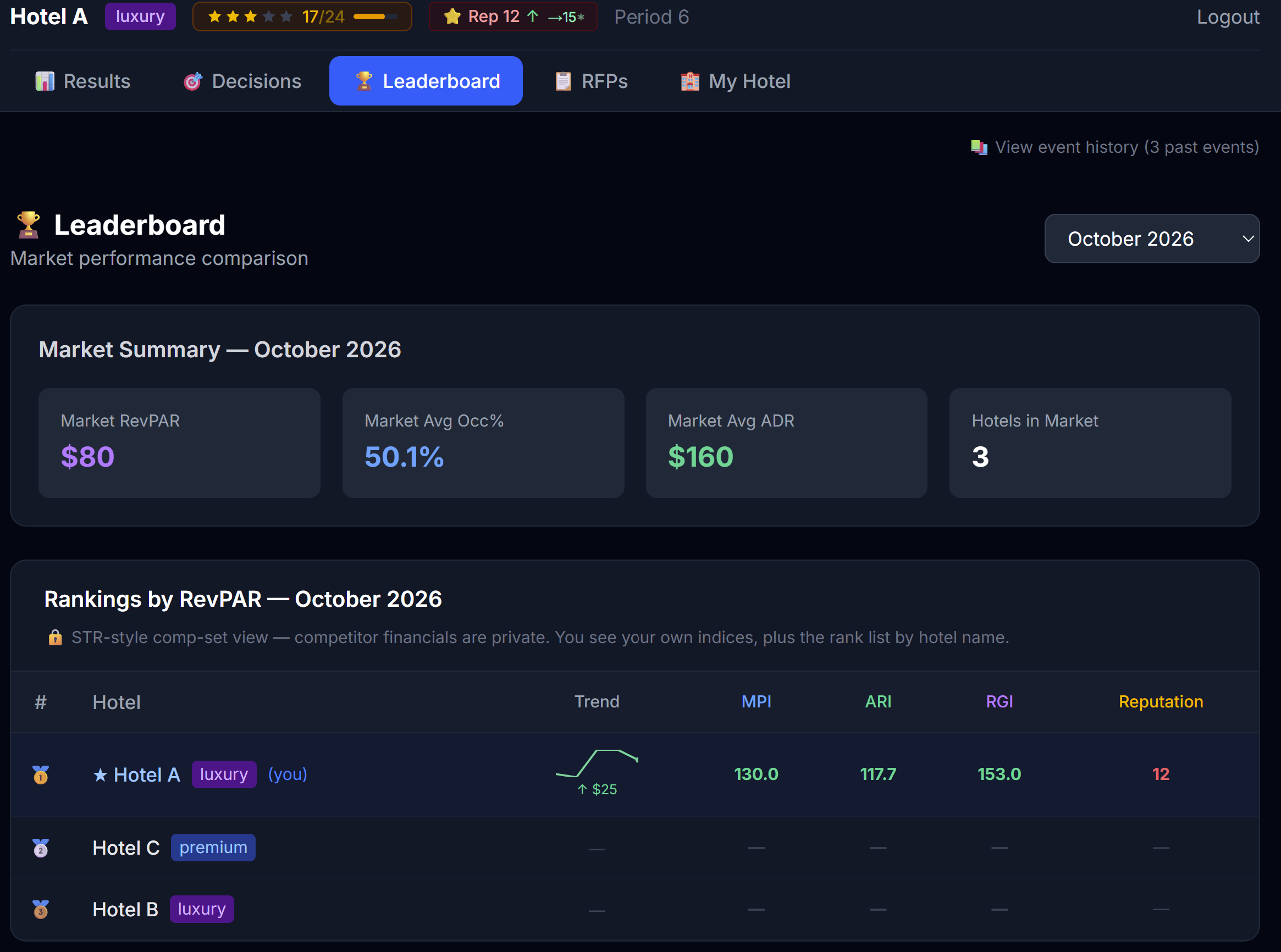 The student leaderboard. STR-style: you see your own numbers and competitor indices, not their dollar values.
What's actually shown
The leaderboard is built to mimic real-world hospitality industry reports (STR / Smith Travel Research). It deliberately:
| You see | You don't see |
|---|---|
| Your own occupancy, ADR, RevPAR, revenue | Your competitors' dollar/percentage values |
| Competitor names | Competitor amenities, marketing, brand |
| Your indices vs the market — Occupancy Index, ADR Index, RevPAR Index | Per-competitor breakdowns |
This is deliberate. In the real world, hotels don't know exactly what their competitors are selling or how much they're spending. They know aggregate market data.
How to read the three indices
Each index compares you to the average of your competitive set (typically hotels of your type).
| Index | What it means | What 100 means |
|---|---|---|
| MPI (Market Penetration Index) | Your occupancy vs the average | 100 = you're at average occupancy. Above 100 = you're getting more than your fair share of rooms sold. |
| ARI (Average Rate Index) | Your ADR vs the average | 100 = you're priced at average. Above 100 = premium-positioned. |
| RGI (Revenue Generation Index) | Your RevPAR vs the average | 100 = you're earning your fair share of revenue. Above 100 = winning. |
✅ RGI > 100 is the headline number. It means you're winning more revenue per available room than the average hotel in your set. That's the simplest definition of "doing well."
The three patterns
Hotels with MPI ≠ ARI usually fall into one of three patterns. Recognizing them helps you decide what to do next.
| Pattern | MPI | ARI | RGI | Strategy |
|---|---|---|---|---|
| Premium positioned | Below 100 | Above 100 | Likely above 100 | Selling fewer rooms but at higher rates. Hold the line. |
| Volume play | Above 100 | Below 100 | Sometimes above, sometimes below | Filling rooms at discount. Risky — protect mix. |
| Squeezed | Below 100 | Below 100 | Below 100 | Losing on both. Step back — what's broken? Product, brand, or pricing? |
| Dominant | Above 100 | Above 100 | Well above 100 | The rare both-and. Hard to sustain. |
Common mistakes
Chasing the leader's price
The leader's pricing is their answer to their product. If they have stronger amenities, brand, and reputation, their $220 isn't your $220. Match strategy, not number.
Optimizing the wrong index
Going hard on MPI (raising occupancy) by dropping price is easy but often nukes RGI. Going hard on ARI by raising price drops MPI fast and can torpedo RGI too. Optimize RGI. That's the integrated outcome.
Reading one period as a trend
One period of low RGI may just be bad luck (a competitor got an RFP, an event went the other way). Two periods is interesting. Three periods is a pattern. Don't change your whole strategy on a single data point.
What's NOT on the leaderboard
Things that matter for your hotel that the leaderboard doesn't show:
- Your operating profit (revenue minus all costs). RGI optimizes revenue, not profit. A high-RGI hotel that's burning cash on channel commissions and a money-losing brand isn't really winning.
- Your cash position — easily checked on the top bar pill.
- Your reputation and service score — long-term assets that compound.
Always read leaderboard alongside your full results, not in isolation.
Next
→ Chapter 10: Reputation & Service Score